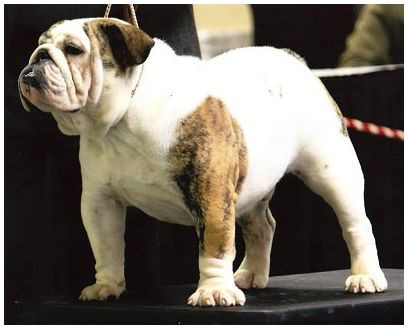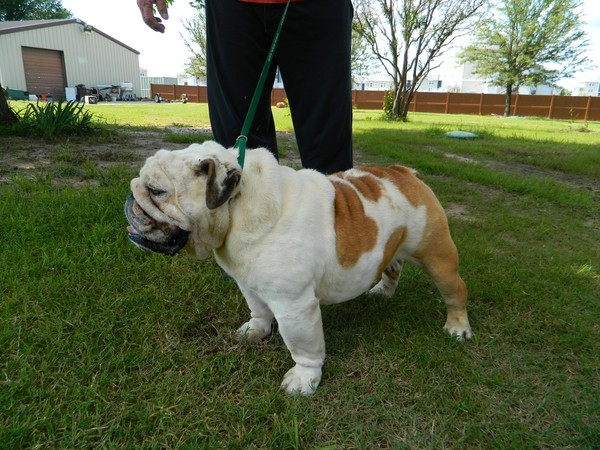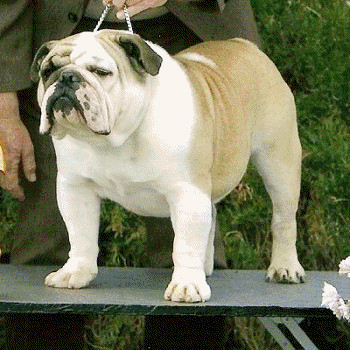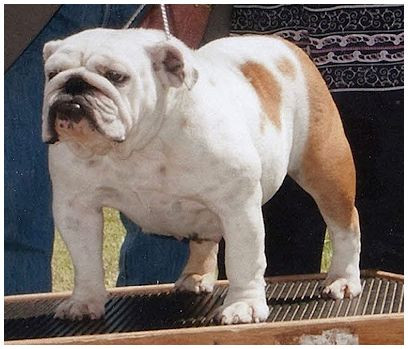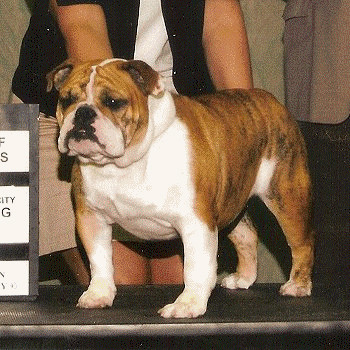
Yes, unquestionably.
Anything is OK - except those moose antlers. Moose are sacrosanct. Tutus, sunglasses, leather jackets, Georgia Bulldog T-shirts, Tuxedos, Mack Truck T-shirts, etc., etc... are all OK.
See Q1 above.
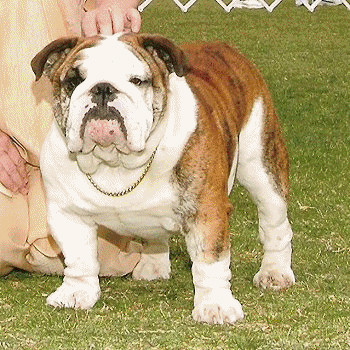
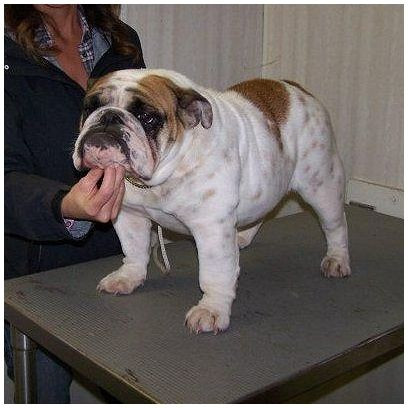
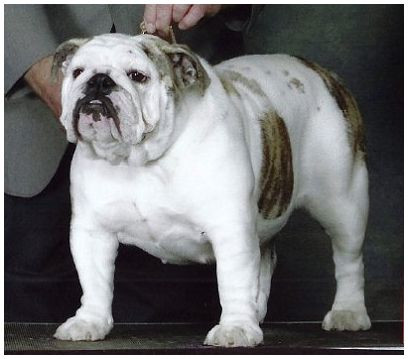
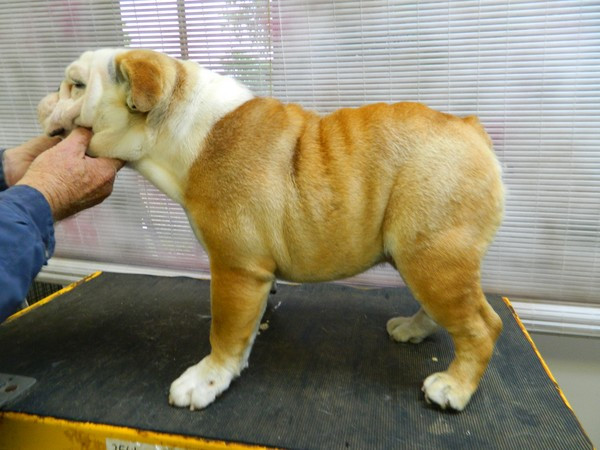
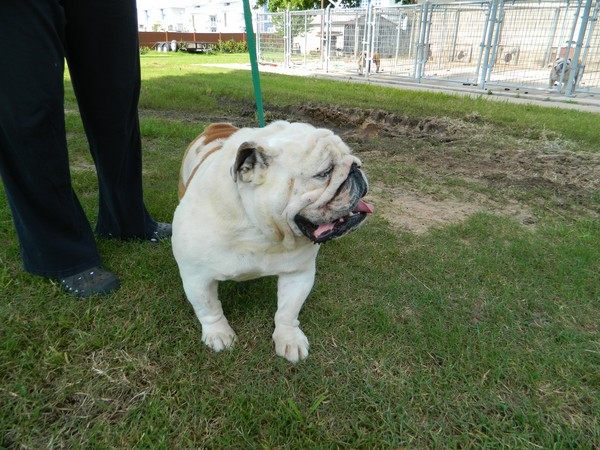
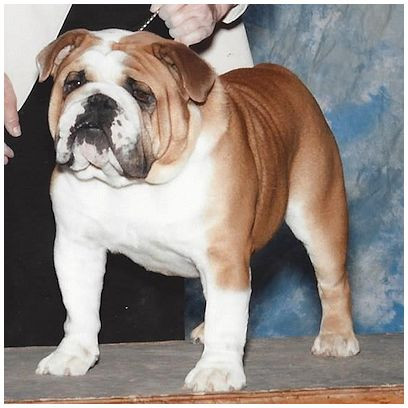
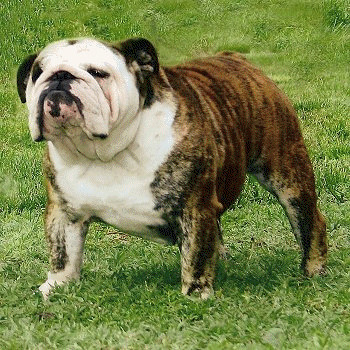
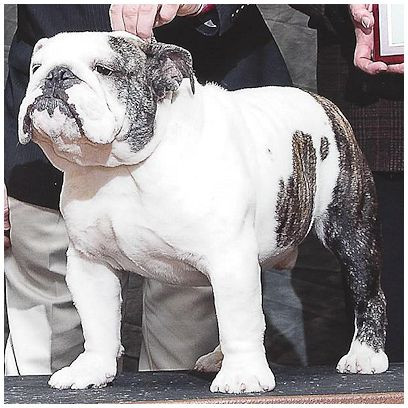
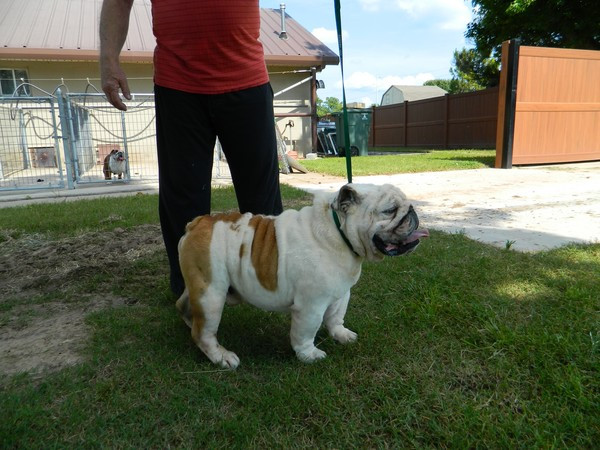
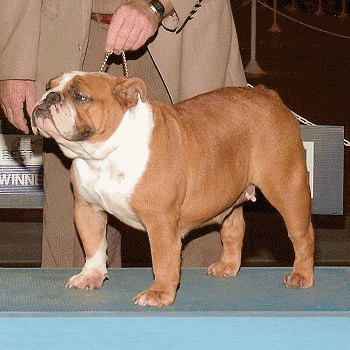
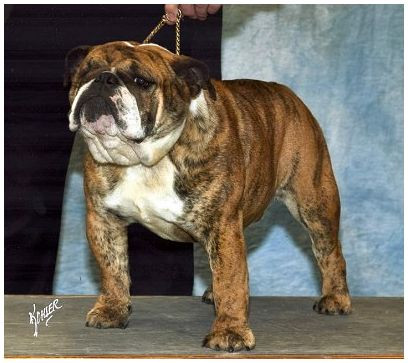
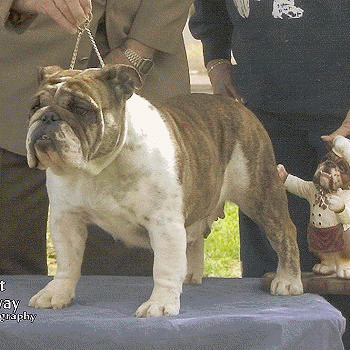
There is no such thing as an English or British Bulldog. Members of the breed are simply called Bulldogs, as in - The Bulldog.
On the French Bulldog (by Jack Segall):
The French Bulldog, incidentally, derived from miniature or dwarf Bulldogs sent to France by the English who did not want them…this in the late 1800’s… The genes for miniature still exist in the Bulldog line, and I own one who is a perfectly proportioned 30 pound dog. Before the late ’50’s, Bulldogs were shown at AKC shows in Under and Over 40 pound weight classes, so small dogs have been around until fairly recently.
On the ‘Olde English Bulldogge’ (by Aaron Dial)
Developed in the 1970s, the Olde English Bulldogge is a recreation of the 18th-century bulldog. The breed’s creator, David Leavitt, was heavily involved with the AKC show-type Bulldog at the time, thoroughly loving the bulldog nature, but not so enamored with their breathing and breeding problems. Armed with considerable knowledge of bulldog history and canine genetics, Leavitt used a linebreeding scheme involving the present-day Bulldog, the Bullmastiff, the American Pit Bull Terrier, and American Bulldogs. Though the “Oldie’s” bloodlines are strongly steeped in combat stock, Leavitt deemed aggressiveness a fault. He sought instead to recreate the original bulldog’s tenacity, fierce appearance, power, and athleticism, but in the guise of an over-all friendly fellow. Considered intelligent, clownish, and loyal, the Olde English Bulldogges are quickly going “over the top,” and are increasingly present at rare breed shows all over the North America. Dogs should weigh at least 60 lbs. and stand at least 19″ at the withers. Bitches should weigh at least 50 lbs and stand 17″ tall. The moderately wrinkled head is large in proportion to the body with the skull deeply sunken between the eyes, extending up the forehead. The muzzle is short (though not as short as the AKC Bulldog) and broad. The coat is short, close, and medium fine. Acceptable colors are the brindles (red, grey, or black), solid white, fawn, red, or black.
For more information, or breeder referrals, on the Olde English Bulldogges, contact Standing Stones Olde English Bulldogges in the US at (203) 379-0378.
Well, (and maybe a AB aficianado can help me here), ABs were bred for Big Game Hunting and they use a little more force to bring their (smaller) prey down. (See also Q6 below).
[From Aaron Dial, with a little editing by Wilf]:
The AB (indigenous to the sourthern US) was bred as a farm guardian to protect livestock. It resembles the basic bulldog description (wide chest, big head, etc.) but a good working AB should weigh 90 lbs (according to the boar hunters, ABs much more than 100 lbs are too slow), and its muzzle should be a bit longer than the Bulldog’s for hot-weather work. Its bite should be undershot to maintain a hold, as fiercer prey can do considerable damage given the opportunity. A scissor bite would not be suitable. An athletic AB is quite popular for boar hunting, a sport that has taken the lives of many good dogs. However, a good AB is something to behold in this bloody endeavor, which is why they are emerging as the dog of choice for the task. There is great argument within the fancy just now as to what direction the breed should take, i.e. athleticism versus bigger is better and biggest is best. [All hunting flames cheerfully forwarded to rec.hunting]. [Again, the American Bulldog is more of a ‘performance’ dog, whereas the Bulldog is more of a couch potato].
Some people think Bulldogs were bigger (95 lb range) and some think they were about the same size as today’s variety. However, Bulldogs were more like a flea on a bull’s nose than a massive dog which would fight with the bulls. They would grab onto the bull’s nose and hold on until the bull was so tired it couldn’t fight anymore. It must be remembered that although Bulldogs may look strange to some, everything about them (their short stature to avoid being "hooked" by the bull, their short snout to allow them to breathe while holding on to the bull, etc.) was bred for bullbaiting. The dogs didn’t always win. The bull was also restrained by a tether (with a rope about its neck, approximately 4 or 5 yards long).
So the bull’s blood would flow down the Bulldog’s face, under its chin and down, rather than into the dog’s eyes. Their noses are tipped back so they can still breath while keeping ahold of their mouthful. Doesn’t conjure up a pretty mental picture, does it?
Easier to hold on, and not let go.
So when the Bull shakes it would be less likely that the dog’s back would be broken. In physical terms, this moves the center of gravity nearer the axis of rotation in order to minimize the angular moment of inertia…
No. They are just very strong, and stubborn (tenacious), and if they don’t want to let go, they won’t.
No, originally the forerunners to the Bulldog were used along with Mastiffs and Bull Terriers. Bull Terriers and Mastiffs were considered too large and slow in the ring.
Yes. Bears, badgers, and even monkeys were occasionally the first-round draft choices of the blood sport promoters.
Yes and yes. But remember that the fighting “rings” were the forerunners of the show “rings”. Not that this makes it any better. [In fact, it kinda smacks of kickboxing, a sport not without promoters today…]
HAHAAHAHAHAHAHAAHAHAHHAHAHAAHAHAA !!!!!! Sure, they are quite capable at hunting dust bunnies, but that’s about it.
No. Most, if not all, the fighting spirit has been bred out. They are still pretty stubborn in general, but very loveable. (To quote the Book of the Bulldog, “They won’t start very many fights, but they may finish a few”). Generally, they have a lot of patience, and they are very tough. This is why they are good with kids; they can take reams of abuse. They tend to be meatheads, and might harm a child by accident, so supervision is still recommended. They even have a reputation of being particularly good with cats [Craig: My Bulldog pup has established a particularly good relationship with my marmalade tabby Duncan, the King Kong of the feline world. Wilf: Yeah, my bulldog *loves* my cat and my cat (an old grumpy 11 year old) even likes my bulldog!!]
No. Although it is often unclear what people mean when they say “Pit Bull”. They could mean American Pit Bull Terrier, or just a dog which was originally bred for pit fighting (and has bulldog-X blood) or most likely they really don’t know what they are talking about. The press usually defines “Pit Bull” as a dog that bites.
Terriers and Bulldogs were crossed to yield the Bull and Terrier which then led to the Bull Terrier and the so-called “Pit Bull”. (Well, even this is debatable. Some people believe there is no Terrier in the American Pit Bull Terrier. Some people believe that the Pit Bull is closer in looks and character to the original Bull baiting dog. The general feeling of most Bulldog lovers is a cheery “who cares” ?)
Bulldogs were used for pit fighting (historically) but any aggressive nature (or gameness) has been (in general) bred out. They are still stubborn, singleminded and rather impervious to pain.
Bulldogs, in general, are much less hyper than, say, an AmStaff or a American Pitbull Terrier, shorter, and stockier. Again, Bulldogs are not performance dogs, they are *clowns*. And no, not all “Pit Bull” type dogs eat people just for fun. Pit Bulls were bred for fighting other dogs, not for eating people. A fighting dog cannot be aggressive to humans, since handlers must break up the fight. In other words, a well bred Pit Bull is not aggressive to humans (and as such, a Pit Bull doesn’t even make a great guard dog). However, as with any dog (which has the size and strength to do damage), a combination of poor genetics, poor breeding, bad owners, and a little bad luck can lead to a problem dog. (And of course, media hype plays a roll in this as well). So make sure you do your research and find a good breeder with a good history of producing good dogs !!
No. They *like* people. Like most dogs, one might protect you if you were in trouble, but it is unlikely. However, most people are terrified of Bulldogs, so this is (sometimes) protection enough. [One can use this as a convenient barometer of good taste — those terrified by Bulldogs are Philistines] Whether or not *any* dog should be used for guarding is good flamebait.
No, they are very quiet in general. They do snore, belch and can be flatulent, so they tend to be noisy in other ways. Some people think this is comforting. Well, at least two people do because my SO does and I do. The contented snore of the Bulldog by my bed is the best lullaby that I can imagine.
Another imponderable…no one is sure why they are so stunning, they just are.
Inform me. I will deal with them or utter some sage and witty repartee like “So’s your momma!”.
As a breed, they have large heads and small hips and therefore small birth canals. Well, that’s the commonly held belief which is probably just a myth.
Here are some other reasons for C-sections:
Bulldog Bitches, due to their high tolerance for pain, often ignore nature’s signals to “Push” the puppies out. Any dog can take a long time to deliver an entire litter of puppies. An hour or more between pups is not unusual, and if the litter is large, the delivery time can last 8 or more hours. Bulldogs will just forget it, and go to sleep.
Secondly, Bulldogs have a higher than normal record of producing “Anasarca” puppies. These are fetuses that do not drain fluid in a normal manner, and end up as water-filled puppies, often weighing two to three times what a normal pup weighs. They are so large that they will not fit through the pelvic opening in the birth canal. If this is one of the first puppies in line to be delivered, none behind it will get out. Until the availablility of ultra sound, there was no way of predicting if the bitch had one of these in-side her. Even with ultrasound, it is difficult. A number of years ago, U of Michigan conducted a study trying to determine what caused this problem (it also happens with human babies). Ultra sound was used to try to determine when the water problem developed during the gestation period. No predictable patterns were discerned. The problem seemed to be related to a zero thyroid function in the fetus. Generally, these pups do not live more than a few minutes, even born through C-Sections.
So the C-Section is routinely used to avoid having to do one on an emergency basis, whether due to an Anasarca pup, or just to make sure that all have been delivered naturally… how do you know how many are there? The high value of a bulldog puppy makes it cost effective to do the C-section rather than risk loosing even one puppy.
Anasarca may be hereditary, but after several years of study supported by the Morris Animal Foundation, so familial connects were found. Repeat breedings of the same sire and dam did not produce Anasarca puppies.
Here are some arguments against C-sections:
Not accepting the puppies is the down side of C-sections. The mothers internal hormones are not yet in action, and she doesn’t know that she has had puppies. Sometimes there may be near disasters in the first 48 hours. A hormone shot can be given that brings the milk in and starts the maternal instinct going. The length of time between birth and acceptance depends on when, in the gestation period the C-section was performed.
As you can see, discussing whether or not it is right or wrong to breed dogs which are often born in this manner is good flame bait.
Well, Sourmug is just the name that is sometimes used to explain the look on a Bulldogs face. The enlightened Bulldog owner prefers to think of it as a look of contentment.
They shouldn’t be. As is the case with any dog, regular exercise and a proper diet will control any weight problems in Bulldogs. However, they are *very* solid dogs. Their build is very wide and not very tall. So even though they might look fat, they are just stocky. (Also, like any dog, you should be able to feel the ribs easily, but not able to see the ribs). Excess weight puts undue strain on the heart and joints.
Remember, the AKC breed standard says: “The general appearance should suggest great stability, vigor and strength”.
However, the AKC breed standard also says: “the size for mature dogs is about 50 pounds; for mature bitches about 40 pounds”, and this is routinely ignored.
Well, they do have a short coat but they are *not* a non- shedding dog.
I dunno; it must be in our genes…
No. They are not cropped, they just have short tails. The tails come in essentially two varieties: spiked or screwed [Craig: I could come up with a very off-color remark here if given a minute or so, but given the readership of rpd, it may not be much appreciated].
Following by Jack Segall:
The tail can be almost any size and shape, as long as all of it is stays below the base of tail. In breeding, a screw tail will usually be dominant, that is, both parents must have straight tails to get one. In judging a bulldog, the tail is worth about 2% of the score, and this includes not only its shape, but its placement on the back. Its base should be low on the down side of the rump curvature. Most tails do not need any special care. Occasionally, the root of a screw tail will be buried deep inside the dog – a finger inserted next to these tails will go in to about the first knuckle joint. These tails can become infected, particularly if they get wet from swimming or bathing in water that covers the dog. Such an infected tail usually has a strong odor, and may be red and sore to the touch. You may notice the dog scooting around on its rear trying to scratch this area. (Impossible for a bulldog to do!)
Treating the infection requires daily packing of an antiseptic powder deep into the tail cavity. This may take several weeks to be effective. In rare cases, the infection may not be curable, and the tail has to be removed. This is not a simple procedure, although it would appear to be. The removal must be done at the base of the tail, which is attached to the spine. As this area in already infected, the risk of transferring this into the spinal column is great. After surgery, the same sort of antiseptic packing is done. Over the years, out of about 40 dogs that we have owned, 4 or 5 have had these deep set tails, three have become infected, and one of these required amputation.
No. Very likely not. But the breed standard says large head and low to the ground. So bigger is better and lower is better. This too is good flame bait.
Following by Jack Segall:
The ears are supposed to have a “Rose” shape, and to help the cartilige form into this pattern, the ears are [sometimes] glued into the proper shape. We use a surgical glue, for colostomy bags, made by Duo Adhesive. If you do not know what a Rose Ear is supposed to look like, have someone who does know look at the dog. If the ears are already rosed, there is no need to glue them. If the ears kind of hang like a hound dog, called a button ear in bulldogs, then they should be shaped. Five months is about the limit on doing this. If you figure out what the ear should look like, glue all parts that fold together touching another part of the ear to hold the ear in the proper shape. The glue will stay on for a week or so, and can be rubbed off like rubber cement Make sure that it is SURGICAL adhesive, not the stuff used for false eyelashes. Our local drug store has to order the stuff for us, which usually takes a day.
Not much, really.
For a Bulldog of light coloring, sometimes tear stains might develop in the folds of the skin on the face. First, the source of the tearing should be determined. Some is normal, but an “entropian”, where the eye lid has turned inward, and eyelashes are rubbing the eyeball will cause excessive tears. This will also cause eye ulcers and loss of sight. The surgical correction is minor, if this is what is happening. As the dog’s head grows, this condition may re-occur, particularly if the face is heavily wrinkled. Cleaning the area with peroxide should help ward of any infection (which rarely occurs anyway), and a little DESITIN baby ointment will act as barrier between the tears and fur to prevent staining. USE VERY LITTLE, as it can rub off on to the furniture and clothing and is in and of itself a “stain maker”.
Putting a little vaseline on your Bulldogs nose from time to time is also a good idea. Sometimes there noses get dry, and putting a little vaseline (or even some vitamin E oil) on it every day or so will help keep it moist.
Mange is something that almost all dogs carry in their blood system. It usually expresses itself early in life, sometimes associated with stress. It is not contagious, and goes away if treated early before the lesions cover large portions of the body. Usually dogs that have it, only show signs once.
Mange can be lethal, if you think your Bulldog has mange, TAKE IT TO THE VET.
For relief, dogs can be dipped in a solution of Mitaban. Your vet can handle the treatments or you can do it yourself.
They will usually lose all their hair in the infected parts, although it doesn’t take too long for the hair to grow back. If more than 50% of the dog is infected it can be fatal, so early diagnosis and treatment is important.
Sometimes in the heat your Bulldog might overheat, especially during exercise. Squirting lemon juice will tend to cut the “slime” and your dog will be able to breath easier.